


Reality Escape Room Experience
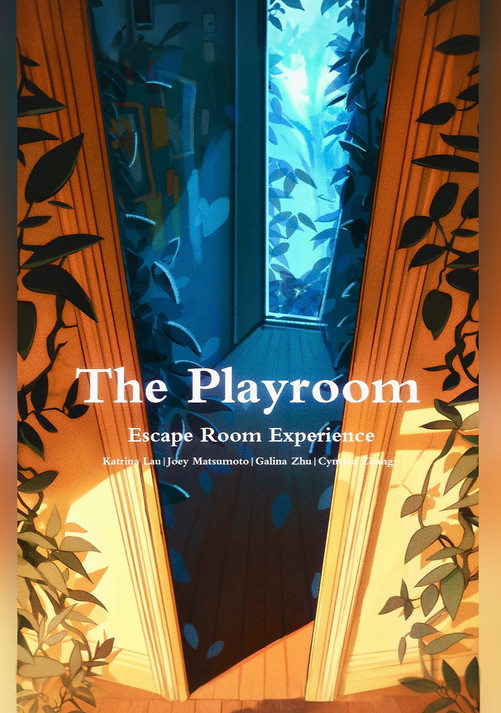
The Playroom
"Some emotion can be so strong, that it travels through time, space, and even death itself." "Dear Investigators, will you choose the truth ...or mercy?"


I can feel something is here, when I saw Saya's diary I was putting a question mark but later everything got answered.
Mary Hawthorne
I love the story! The room gives me a warm feeling and the emotional feeling reminds me of my grandma who passed last year.
Taxi Liu
Good escape room experience. The shift of the room was unexpective! Also it really increased the playability of the room.
Alice Zhi
Memorable and emotional game experience.
A well balance of puzzles and the story.
Tommy Honton
1-3 Players
30-45 Minutes
The Playroom is a reality escape room that emphasizes emotional engagement. It combines immersive experiences, storytelling, puzzle-solving, and emotional involvement to create a unique and memorable experience for players.
The player plays the role of a detective entrusted by Saya's mother
here to investigate the disappearance of her daughter named Saya.
The mother had prepared a surprise birthday party for her, but the Saya vanished right before the party began.
The player enters Saya's room to begin the investigation. Through exploring the traces of her life , the player start to uncover the hidden truth of this family and the room itself…
Meet the Team

Katrina Lau
Product Designer

Joey Matsumoto
Concept Artist/Writer

Galina Zhu
Creative Technologist

Cynthia Zhang
Spatial Designer
Designing & building
Theme & Script:
A Pink Ghost Story
The original idea when I was writing the script was about a lonely girl’s inner world , inspired by liminal space and dreamcore, I wanted to test the boundaries between reality and pure emotions, and use the limited space we have as a plus.
The space was just right for a small bedroom. The player’s role was a psychologist who can travel into people’s thoughts and bring them back.
During the discussion with teammates, we all agreed on the emotional connection we would like to create. Having a specific living character that guides the players from beginning to end was the best way.
We started with 4 family members, then grounded to just a mom and her daughter. I also shifted the narrative from the mom's perspective to her daughter's for a better storytelling.
We designed this room as a tribute to all the mothers out there fighting for their children. It's a story of maternal love and selfless devotion.


The story is a ghost story, without shiny metals and dark blood but soft pinks. It revolves around a single mother battling cancer, who devoted her life to giving her child a fulfilling childhood. Though she ultimately succumbed to the disease, but her love will forever reside in her child’s hearts, and the room becomes the witness and the symbol of this story.
In psychology, the color pink , as the color of diluted blood, is known to have calming effect and a sense of belonging.
In society , people often associate pink with excessive femininity and weakness or childlike. However, centuries ago,pink used to be a color used on military uniforms.
We wanted to re-define the meaning of pink and fight for stereotypes.
Pink is not synonymous with weakness or being 'girly.' It embodies strength and power, just like the mother soft yet powerful love.
Puzzle Design
The puzzles are designed to be fully immersive, inspired by delightful childhood memories and the aspect of children. We integrated activities like piano, butterfly box, diary, doll house.
Players are encouraged to explore and play all the items in reach, giving them a chance to revisit childhood, but with a mission of investigating a missing case.


Logic Puzzle
Physical
Interactive with Actor
Searching
Observation
Math Puzzle
Playtest &REfinement
Observe (emotion, body language, reaction)
Data Gathering & Questionnaire
Evaluation & Refinement
We had refined the flow to make the experience smoother. Since some players had felt lost in the middle of the story, we had added clearer cues through lighting, sound, and actor actions. The Game Master had guided pacing with soft audio triggers, like lullabies or heartbeats.
We had introduced subtle environmental shifts—warm lights and gentle sounds after solving puzzles—to mark emotional progress. The ending had become more cinematic with a soft pink glow filling the room.
We had also placed small “memory objects” like a scarf and drawings to build emotional connection. These changes had aimed to make the experience more intuitive, immersive, and memorable.